










 AI-generated illustration
The Sales Process: From Customer Inquiry to a Paid Invoice
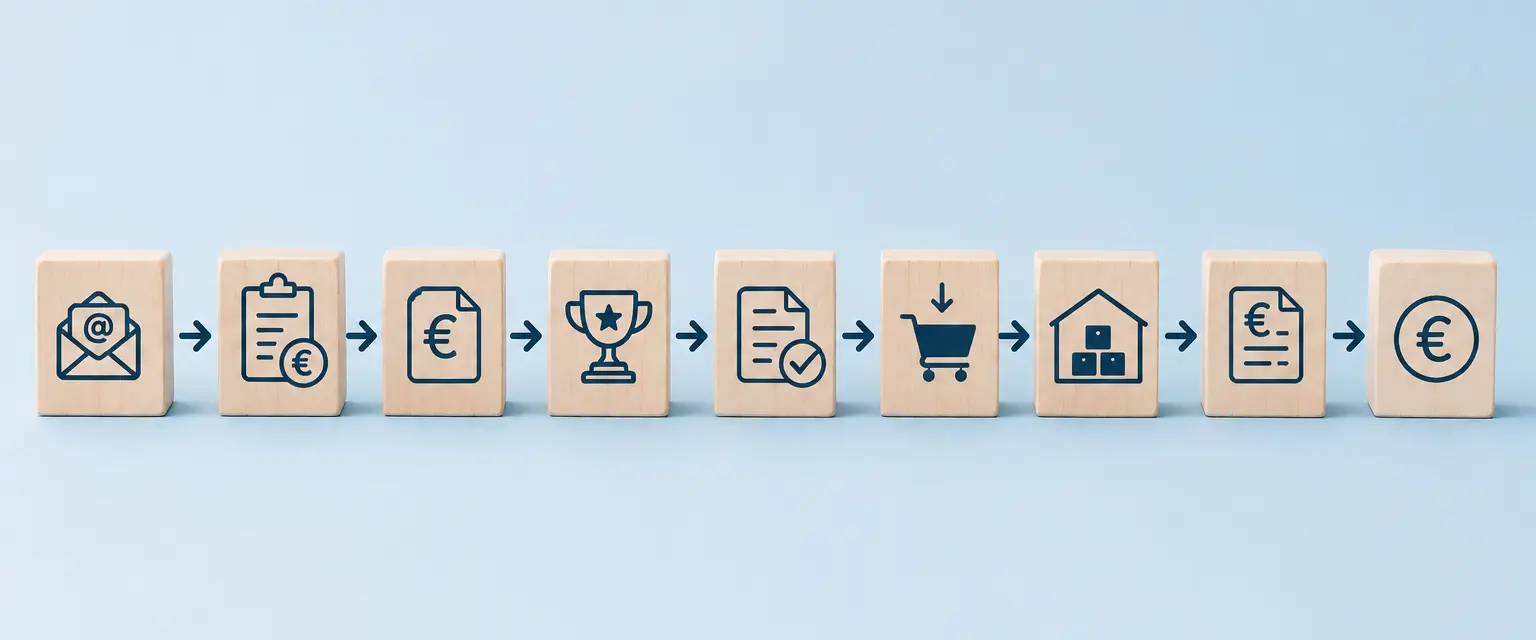
When people hear the term „sales process“, they often imagine a quotation followed by an invoice. In reality, it’s a chain of connected steps. And it’s exactly between these steps where businesses lose the most time and money—information stays buried in emails, prices are copied into spreadsheets, and quotes are manually rewritten into orders.
Let’s walk through the entire process step by step.
1. Customer Inquiry
Everything starts when a customer contacts you. They want to know whether the product is available, how much it costs, and when it can be delivered.
At this stage, nothing has been sold yet—we’re simply collecting information. That’s why every inquiry should be recorded. If it remains only in one salesperson’s inbox, it can easily disappear when they’re on vacation or leave the company.
A properly recorded inquiry also provides valuable data later: what the customer requested, when they contacted you, and how quickly you responded.
2. Requesting a Supplier Price
Before sending a quotation, you often need to know your own purchase price.
For larger quantities, standard supplier price lists usually don’t apply, so you need to request a custom quote.
Many companies skip this step and estimate the price. That can backfire—you may lose the deal because your price is too high, or win it while making far less profit than expected.
That’s why purchase prices should be linked directly to the products you’ll later use in the quotation. We cover this in more detail in the article Price request.
3. Sales Quotation
Now it’s time to prepare the customer’s quotation.
A good quotation is clear, easy to understand, and includes products, prices, delivery dates, and its validity period.
Ideally, it should be generated from the information already collected—not manually copied between emails, spreadsheets, and documents. Less manual work means fewer mistakes. Read more in the article What should a price quote look like.
4. Win or Lose
Not every quotation becomes an order—and that’s perfectly normal.
Sometimes it’s actually better to lose a deal if it wouldn’t be profitable.
Tracking which quotations became orders and understanding why others didn’t provides valuable feedback for improving pricing and sales strategies. More on this in the article When is it better to lose a price quote.
5. Customer Order
Once the customer accepts the quotation, it becomes a sales order.
The document is similar to the quotation but now includes important operational dates, such as when the order was received and when delivery is expected.
Meeting these deadlines has a direct impact on customer satisfaction. We dive deeper in the article How is an order composed.
6. Purchase Order to the Supplier
If the goods aren’t in stock, you need to place an order with your supplier.
Here, two things matter most: purchase price and delivery time.
Purchase orders should always include the supplier’s price so you can accurately calculate the real cost of each sales order. Linking purchase orders with customer orders provides complete traceability. More in the article Purchase order for supplier.
7. Warehouse – Receiving and Shipping
The goods arrive, are received into inventory, and later shipped to the customer.
Although this may seem like additional administration, accurate inventory management keeps the entire process under control.
You’ll always know what’s available, what’s already reserved, and what needs to be reordered.
8. Invoice
The goods have been delivered—now it’s time to get paid.
The invoice should match the customer’s order, including the same products, quantities, and prices, making it easy for the customer to verify.
Correct invoicing and payment terms are essential because this is where the sales process either ends successfully or turns into chasing overdue payments.
9. Payment Received
Once the payment arrives, the sales process is complete.
Now it’s worth reviewing the entire journey. How much profit did the order actually generate? Where did time get lost? Where did you estimate costs instead of knowing them?
This overview is what separates businesses that simply sell from businesses that truly understand their profitability.
Why Manage It as One Connected Process
Each of these steps can exist separately in emails, spreadsheets, or notebooks.
The problem lies in moving information between them.
Every manual copy introduces the possibility of mistakes. Every undocumented step increases the risk of losing information.
When inquiries seamlessly become quotations, quotations become orders, orders become invoices, and everything stays connected, your business saves time, reduces errors, and gains complete visibility into every sales opportunity.
That’s exactly why managing your entire sales process in one system is far more effective than using ten different tools.
Written by artificial intelligence